Building around the core
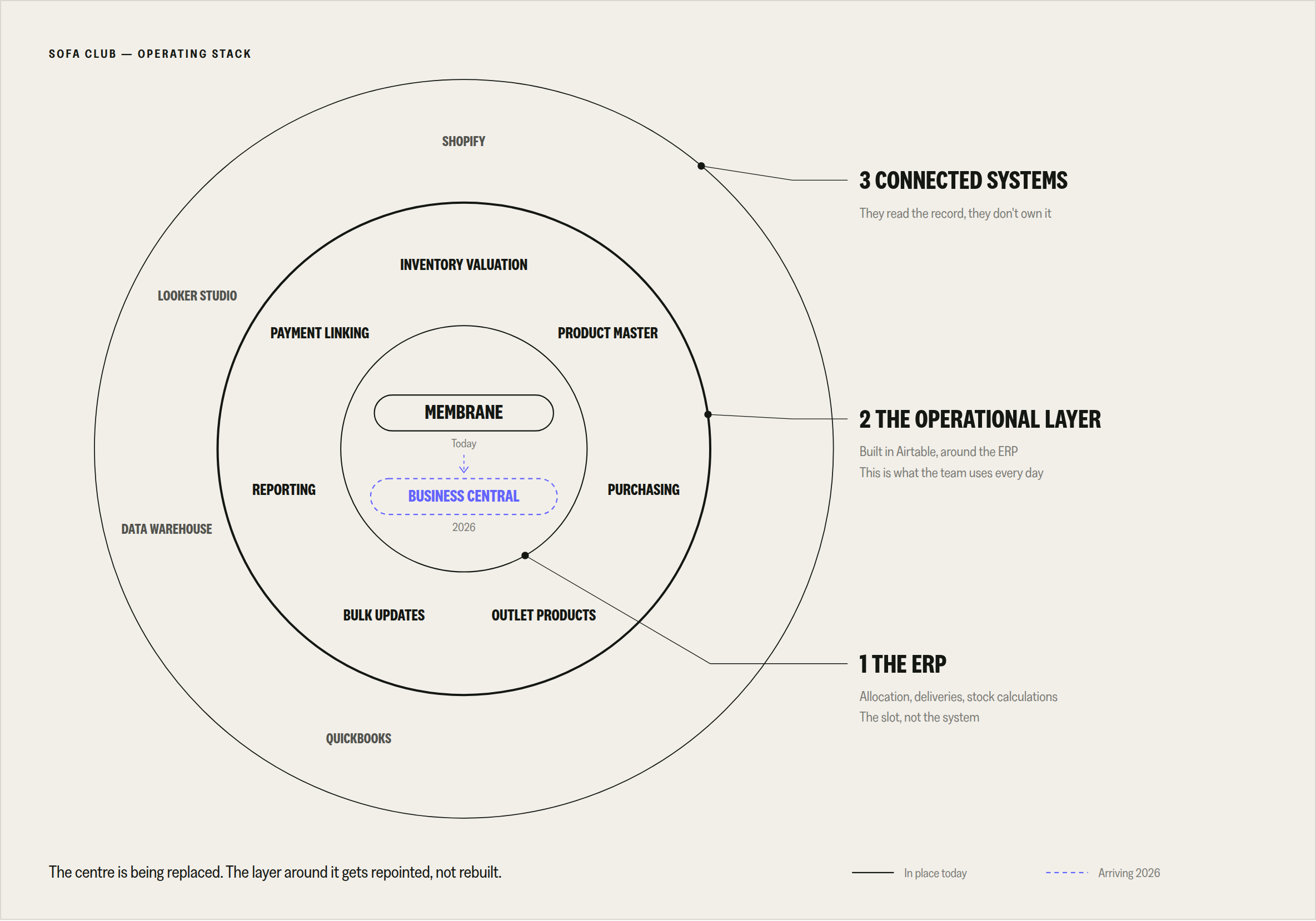
The ERP at the centre was Mehmbrane, Sofa Club's own custom-built system, maintained by an in-house dev team of three. Mehmbrane did the things the team had built into it well: allocation, deliveries, stock calculations, the workflow logic that had grown up with the business. QuickBooks sat alongside for finance, with revenue still recognised at point of sale rather than at delivery. For a furniture business with weeks-long lead times, that meant the numbers never quite told the truth.
Around those two key systems, everything else lived in spreadsheets. Excel for the seasonal buying plan and outlet pricing. Manual SKU duplication for sale events. Bulk price changes done one record at a time. Email chains and Slack threads for supplier-side communication. Mehmbrane was never built to handle a lot of these workflows: three developers were tasked with keeping it running and shipping features for the entire business. There was only so much they could do to keep the Dark Stack at bay.
The functional cost was obvious. Tasks that should have taken minutes took hours. Buying plans lived in spreadsheets only the buying team could read. Payment reconciliation ran across three systems and nobody was across the handoffs. Something like outlet creation for a Black Friday sale was a multi-day setup.
The human cost was harder. The team was burning hours on data entry every week. New starters from Airtable-fluent brands arrived and asked why the basic moves required so much manual work. Senior asks for new operational tooling sat in a queue the in-house team couldn't clear.
This is when Sofa Club brought Nolo in.
The brief was to build around Mehmbrane. Leave the in-house team focused on the core system they understood. Have Nolo own the bigger operational system builds they hadn't had capacity for. Make sure the team adopted what got built.
"Nolo is a great partner. You can become an extension of other organisations. You've helped Sofa Club adopt Airtable, and the apps you've built so far have got some really great feedback."
Essential time with the team
The work started with discovery. Discovery sessions with the buying team surfaced what Liddy’s spreadsheet was actually doing and the rules nobody had written down: how lead times got chased, how seasonal buying rolled across drops, edge cases like what happens if a supplier slips a week. Discovery with the after-sales team mapped what they were copying and pasting into Shopify, and why. Discovery with finance walked through the workarounds for revenue recognition and reconciliation. Only once we understood all of this could our design and development start.
The Nolo Way is to start at the centre, with core product data, and work outwards with functionality landing live before the next sprint starts. This is how adoption and change happens - without overwhelming the team and ripping and replacing everything at once.
Sprints with a defined start and end date. Feedback windows scheduled upfront. The real investment was the time spent in discovery before any building, and the time spent on adoption during each sprint.
Discovery turned up one constraint that shaped the whole build. Mehmbrane's architecture was already organised around purchase orders, but it had no concept of an inbound shipment. Rebuilding that inside Mehmbrane would have put the work straight back on the three developers we were there to unblock.
So we moved a step back instead. Purchase orders and range planning came out of Mehmbrane and into Airtable. Only inbound shipments got sent across. Mehmbrane's pre-order workflow and allocation engine kept running exactly as built, on data that was now being managed somewhere else entirely.
Components Sofa Club adopted
- Product Master. Costings, margin and range planning had no home before this. Every product, every part, every variant now sits in one record, with Shopify, finance and the buying team all pulling from it. It's also what the Purchasing app was built on.
- A Purchasing app. Tracks POs, manages lead times, and feeds reporting downstream. The buying logic that used to live in Liddy’s head is now visible to the rest of the team.
- Outlet products workflow. Creates outlet variants from main lines on demand, with adjusted pricing and SKU logic.
- Bulk update tooling. RSP changes pushed across thousands of products at once, with pricing flowing back into Product Master.
- Container tracking. A ShipsGo integration on every inbound shipment. Click a container reference and see where it is in the world.
- A Payment Linking app. Matches shipments, purchase orders and payments without anyone reconciling across three systems by hand.
- Inventory valuation. Daily stock value calculated from multiple data sources.
- A reporting layer. Shopify as the source of truth for orders, feeding a data warehouse, surfaced in Looker Studio.
The spreadsheet that mattered most
Supplier payment terms now sit in the system, attached to the purchase orders and shipments they belong to. That gives finance three reads on the same question.
What's committed on a purchase order. What's actually inbound, and the invoices that will land against it. And what the invoicing would look like month by month if they executed everything currently open to buy.
It re-times itself. When a shipment slips a week, every payment milestone attached to it moves with it. Cash owed to suppliers used to be the most important spreadsheet in the business, rebuilt by hand every time something moved.
For a business buying high-value stock on long lead times, that's the number everything else depends on.
The hardest six months
The first six months on the Purchasing app were the hardest part of the engagement. Liddy had built her spreadsheet over years, and replacing it meant asking her to put years of furniture-buying judgement into a new system. She wasn't keen. Discovery sessions surfaced the rules. The build kept her logic and put it on top of a system everyone else could see. The interface was new. The judgement underneath was hers. By the time she went on maternity leave, Liddy was using the app every day. Her cover being able to land in the role and work in her new system from day one rather than trying to unpick a spreadsheet was a huge win.


.png)