The operating system for the AI organisation
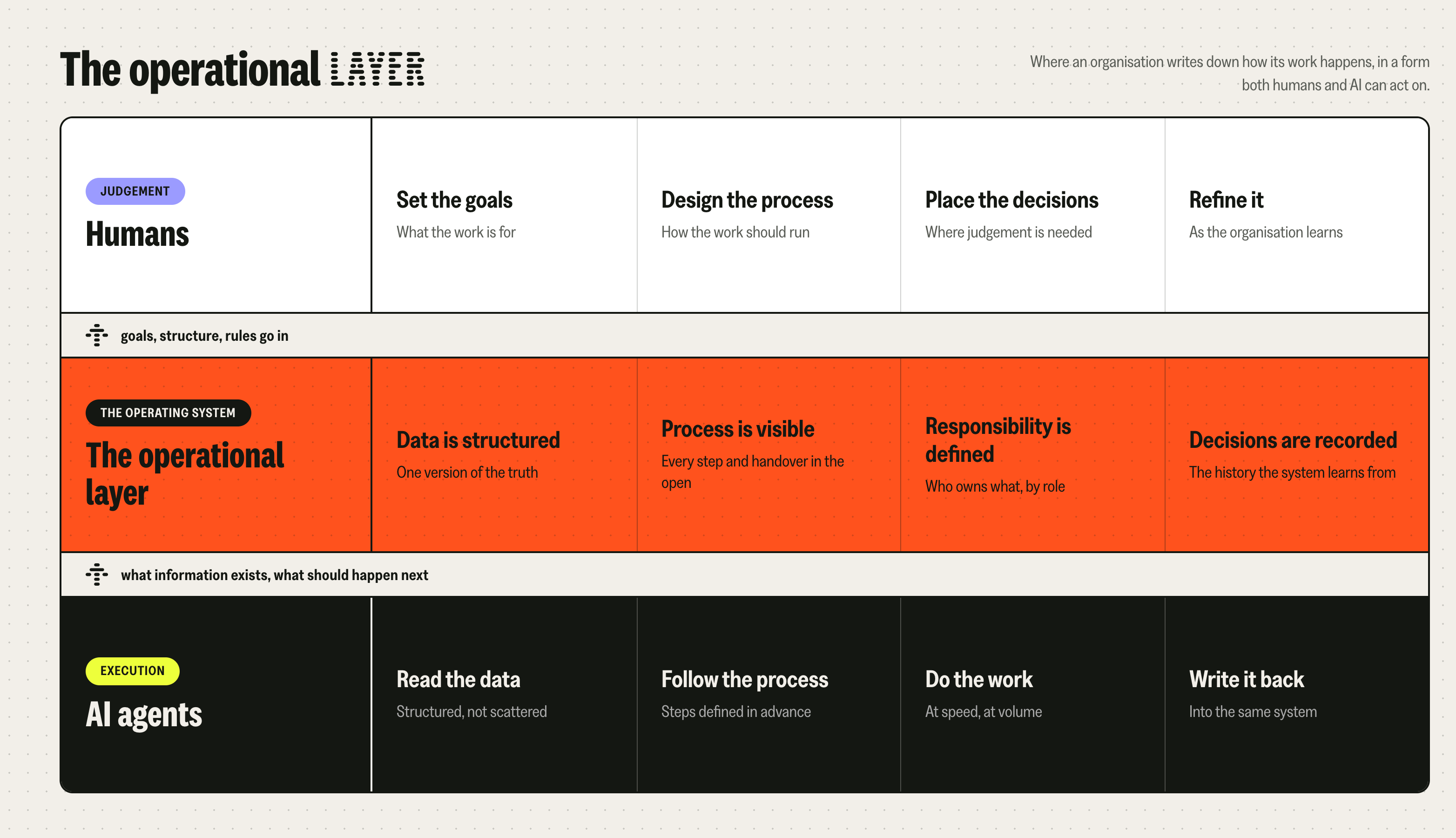
If AI agents execute work and humans provide judgement, organisations will need a new operating layer that allows both to collaborate effectively.
Systems are becoming the centre of work
There are two connected shifts:
First, AI systems are increasingly capable of performing the execution layer of knowledge work. Tasks that once required skilled humans can now be performed by AI systems with remarkable speed and competence.
Second, this changes the role of humans. As skills become automated, humans move upstream in the process - applying judgement to define goals, design systems, and guide the behaviour of intelligent tools.
But there is an organisational problem hiding inside this shift.
Where does all this judgement actually live?
In most organisations today, knowledge about how work happens is scattered across documents, inboxes, spreadsheets, and people's heads. Processes exist, but they are often fragile, poorly documented, and heavily dependent on individual memory. That model struggles when AI enters the system.
AI systems need structure. They need clearly defined data, processes, and decision points if they are to operate reliably. Which means organisations increasingly need something that sits between humans and AI.
An operational layer.
The rise of the operational layer
In software architecture this layer would be called an application layer or a workflow layer. In operational organisations it plays a similar role.
It is the place where:
● data is structured
● processes are visible
● responsibilities are defined
● decisions and transitions are recorded
Without that layer, organisations rely on coordination through meetings, email threads, and institutional memory. With it, work becomes observable and programmable.
This is exactly the type of environment where AI agents become useful.
An agent cannot operate effectively if it is trying to navigate a maze of disconnected spreadsheets and undocumented processes. But it can operate extremely well when the underlying system clearly defines what information exists and what actions should occur next.
In this sense the operational layer becomes the operating system for organisational work.