The parser never leaves
An agent reading supplier email is a translation layer, and translation layers are permanent.
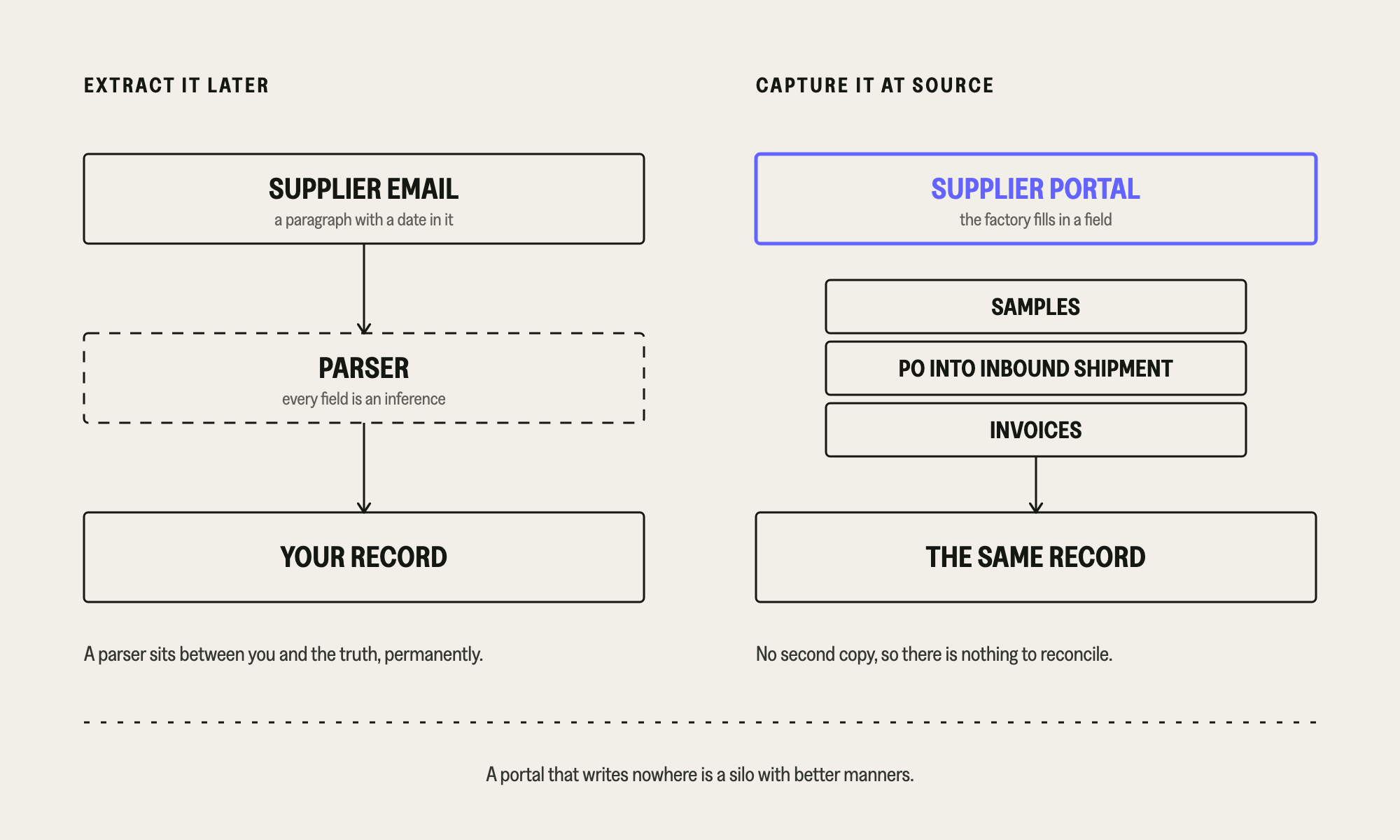
Every field it produces is an inference about what somebody meant. Which of the 3 dates in the paragraph is the ex-factory date. Whether "shipping Friday" means leaving the factory or landing at the 3PL. Whether the quantity in the body overrides the quantity in the attachment.
It gets those right most of the time. The trouble is the other times, and the fact that you can't see which is which without going back to the email.
Then the factory hires someone new who writes differently, and accuracy drops with nothing in the system to tell you it has.
The email is still the source of truth in that setup. Your record is a copy of somebody's prose, and you've taken on a dependency that needs maintaining for as long as you trade with that supplier.
You already have an extraction layer
We ran 3 discovery workshops at a fashion brand in January, 4 years into working with them.
One was with the person who handles inbound logistics. He processes carrier email notifications by hand, keeps an Excel shipment log past 5,000 lines, and types pre-advice documents into the 3PL portal one at a time.
Somebody asked what happens if he's off sick. The room went quiet.
He's the parser. He's been doing the job an agent would do, for years, accurately, and nobody on the outside can see what's on the water without asking him.
The only real question is who does it, and what the business does when they leave.
What changes when the supplier types it
3 things, and the obvious one matters least.
The retyping goes. That's hours back for the ops team, and it's the line that ends up in the business case.
The data arrives structured, because the supplier filled a field instead of writing a sentence. Nobody has to work out what was meant.
And the supplier's version and your version are the same row. There was never a second copy, so there's no reconciliation and no afternoon spent deciding which one is right.
That third one is the whole reason to do it.
The portal that writes nowhere
There's a version of this that makes things worse, and plenty of brands have built it.
A login, some forms, and a separate database nothing downstream can read. The supplier dutifully enters data into a system that doesn't feed the product master, so ops export it and retype it anyway.
That's a silo with better manners. It also makes the AI problem harder, because now the mess has a user interface and looks like it's been solved.
A portal only counts if it's a view of the same record everything else reads from. Same product, same PO, same permissions, same audit trail. The supplier sees a narrow slice and can write to a narrower one.


.png)