The question that kept getting better
One of our clients is a UK fashion brand with a well-built product master in Airtable: supplier records, sample history, approval rates, and critical path all properly linked. We connected that base to Claude via MCP and started with a simple question: which suppliers are performing worst on first-fit approval rates?
The first answer came back fast as a ranked list. Really useful, instantly, but actually not quite what was needed.
The next question was sharper. Cumulative approval rates, factoring in how many rounds each sample took to pass. That surfaced something more with more colour. We pushed on: which suppliers were being overloaded? Monthly sample volume stacked against approval rates by period. Boom. That's when the actual problem came through.
Supplier X had the worst approval rate in the base. They were also receiving 3 times the sample volume of anyone else in the same window. The problem wasn't the supplier themselves or their capability. It was their utilisation. Nobody is working that out from an OG static dashboard.
Then Claude pulled the sample comments - every note left on every record across the entire base, analysed in bulk. The main driver of rejection wasn't even supplier error. It was design complexity: technical specs that almost no supplier could hit first time, regardless of capability.
The whole analysis asked 5 questions. Each answer changed what the next question should be. A dashboard would have answered the first one and stopped, and they'd be thinking about cutting ties with one of their most volume-capable suppliers!
Two things and you're connected
MCP stands for Model Context Protocol - an open standard Anthropic built so AI tools can connect directly to external systems rather than relying on copied or exported data. Airtable's official MCP server is what you want to connect with.
Setup needs 2 things: an Airtable API key and the base ID from the URL of the base you're working in. From there, the base is queryable in plain English.
No exports, no view configuration. Claude reads your live data across every table in the base, and can write back to it too.
That last part is pretty cool. If Claude surfaces a record that needs updating, you can update it. If a status field has been left blank across 40 records, you can fill them. If a supplier's capacity threshold needs adjusting based on what the analysis just showed, you can change it - all without leaving the conversation or touching a form.
The part where nobody has to click anything
Querying data is really just starting point. The more significant shift is what you can do after.
When your interface for operational data is a conversation, the gap between insight and action closes. Ask a question, get an answer, decide what needs doing, do it - all in the same place.
For fashion and CPG brands carrying 200-plus active SKUs across multiple suppliers, the benefit compounds quickly. Every manual update to a sample status, every report built by hand, every piece of supplier feedback that has to be transcribed into a record... The conversation interface starts replacing that work one query at a time.
The catch
Of course there's a catch! None of this works without the foundation.
Claude reasons against your Airtable data at the quality it's been built. A product master where every SKU has a supplier linked, a status tracked, and a sample history logged is a base Claude can do real work with. A collection of unlinked tables with inconsistent field names and manual workarounds gives Claude a minefield for hallucinations and incomplete feedback.
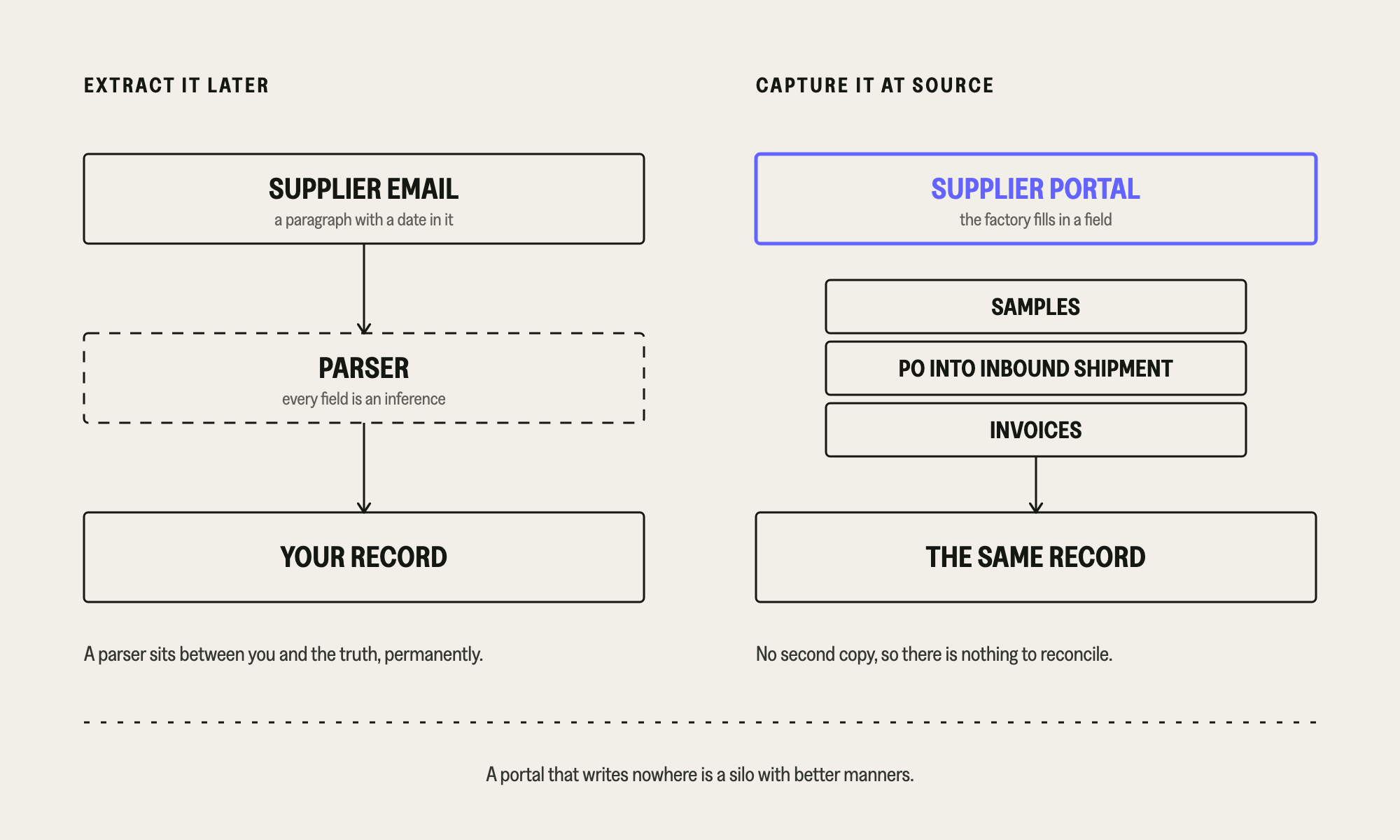
This is why getting data out of the Dark Stack - out of various spreadsheets, email chains, WhatsApp threads, and shared drives - and into a properly structured schema isn't just about visibility. It's about making the data usable by something that can actually reason against it.
The path looks the same for most retailers who go on this journey. First, structured data: proper schema, fields that mean something, records linked to each other. Then visibility: the ability to see how products are moving through a critical path, what's on order, what's overdue. What we're describing here comes after both of those. Intelligence running against a foundation that was built properly and didn't take shortcuts when the data got complicated.
The brands getting to this fastest are the ones who did that work first.
If your data's in order, you're closer than you think
Airtable's MCP server is available now. The Claude connection is available now. If you have a well-structured base, you can set this up without a development team.
One of our clients found a utilisation problem that had been invisible in their dashboards for months. It took 45 minutes of conversation with their existing data.
That's what a well-built base is now capable of.