MENU

From Idea to SKU in 4 Weeks

Some brands plan their product calendar 12 months out. Complex plans theirs 4 weeks out.

The model is built around cultural moments driven in real-time by artists, athletes and global trend-makers. These moments don't just arrive on a neat seasonal schedule, and the operation defininitely can't stop to recalibrate when they do. Complex by name... external creative partners, made-to-order manufacturing, 40 to 50 people across marketing, ecommerce, logistics, and supply chain: all moving at the same time on a 28-day clock.

Joe Vitello built that machine. He joined Complex as an ecommerce assistant, spent years doing the work before designing the systems around it, and now leads the Integrated Business Systems function he founded himself.


"Empowering the people with the highest fidelity information to be the ones to codify that information in the system."

Joe Vitello, Director of Integrated Business Systems, Complex

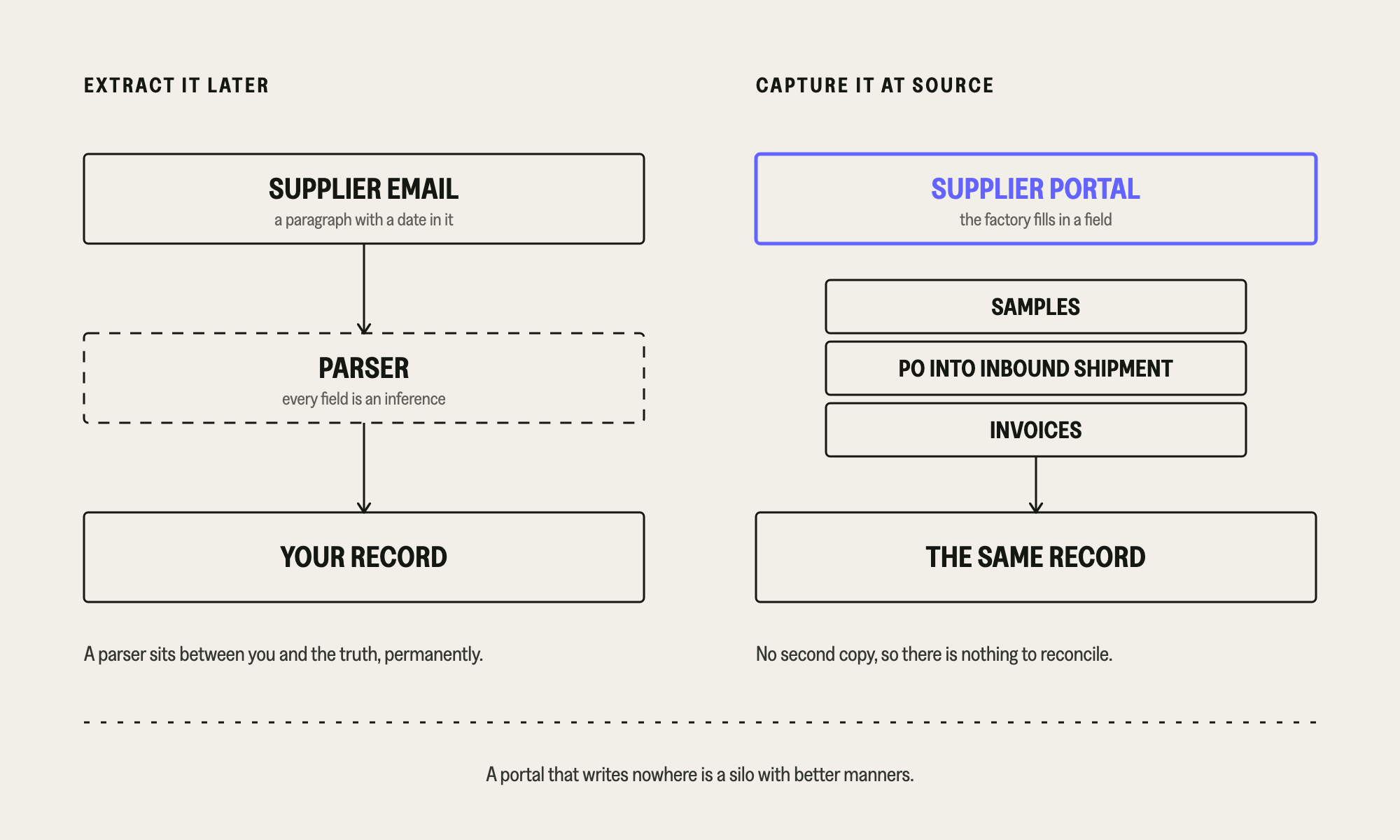
The design principle at the centre of Complex's operation is data ownership at source. Joe built the supply chain so whoever raises a purchase order enters the preliminary data directly into Fulfil. Logistics enriches it at the handoff point. The storefront pulls from there. No one transcribes from a spreadsheet, and no one sends a CSV to a coordinator to upload later.

This sounds simple, but most ops teams get it backwards. The default is to centralise data entry: have one team maintain the system, everyone else feeds them information and waits. It feels like control. What it actually creates is a team that's permanently behind, a growing queue of manual updates, and accuracy errors at every handoff. When the person who knows what changed isn't the one who can act on it, the system degrades.

The compressed sprint has its own internal logic. A 4-week product cycle runs the same milestones as a 12-month one: approval gates, vendor confirmation, logistics briefing, storefront prep. They're all still there, just narrower and more concurrent. The trade-off is creative flexibility: artwork locks earlier, decisions get made once. The teams that handle this way of working the best understood that going in. They knew what they were signing up for because they knew this was the only way to deliver.

Joe understands his value and his unique perspective. He calls it operator's advantage. Having spent years as the person doing the work before designing the systems around it, he knew exactly where they break: not from analysis, but from experience. The platform is deliberately simple as a result. Overly complicated systems get worked around under pressure, and Complex is always under pressure.

The point where all of this gets tested is the drop itself. Complex runs a direct integration between Fulfil and Shopify: ERP stock levels feed what the storefront shows as purchasable. A 30-minute sync failure during peak traffic generates thousands of orders for inventory that no longer exists. Joe's architecture exists to prevent that scenario. Everything upstream serves the reliability of that one integration point.

3 things from this episode

01
The person closest to the data should enter it. When ops becomes the middleman for every function, accuracy erodes and you become the bottleneck rather than the backbone.
02
A 4-week product sprint uses the same calendar as a 12-month one. The milestones are identical: you're condensing them, running things in parallel, and making hard calls on creative flexibility earlier than you'd like.
03
Prevent oversell at all costs. Half an hour of disrupted ERP-to-Shopify sync during a drop can mean thousands of orders to unwind. It's the thing that catches first-time drop operators completely off guard.