MENU

Stop building critical paths. Start Understanding what happens on them.

Every brand I work with has a critical path. A spreadsheet or a Gantt chart or a board somewhere that says: concept by this date, sampling by this date, production by this date, launch by this date.

And almost none of them follow it.

The critical path exists. The dates are in there. But the only way anyone knows whether things are on track is by asking each other. Emails, WhatsApp messages, and stopping someone at their desk. "Where's that sample?" "Have we got the fabric?" "Is that approved yet?" Every one of those interruptions pulls someone out of the work they're actually doing. Everyone's productivity suffers, and the critical path just sits there, getting updated after the fact, if it gets updated at all.

I've been inside the operations of fashion and consumer brands for three years now, and the pattern is the same everywhere. The critical path is treated as a project management tool: a tracking artefact that someone has to maintain. That framing is the problem. And it's why internal project management, in its traditional form, is collapsing.

The tracking trap

The instinct when things aren't being followed is to track harder. More columns. More status fields. More update meetings. Hire a PM to chase everyone and compile a weekly report.

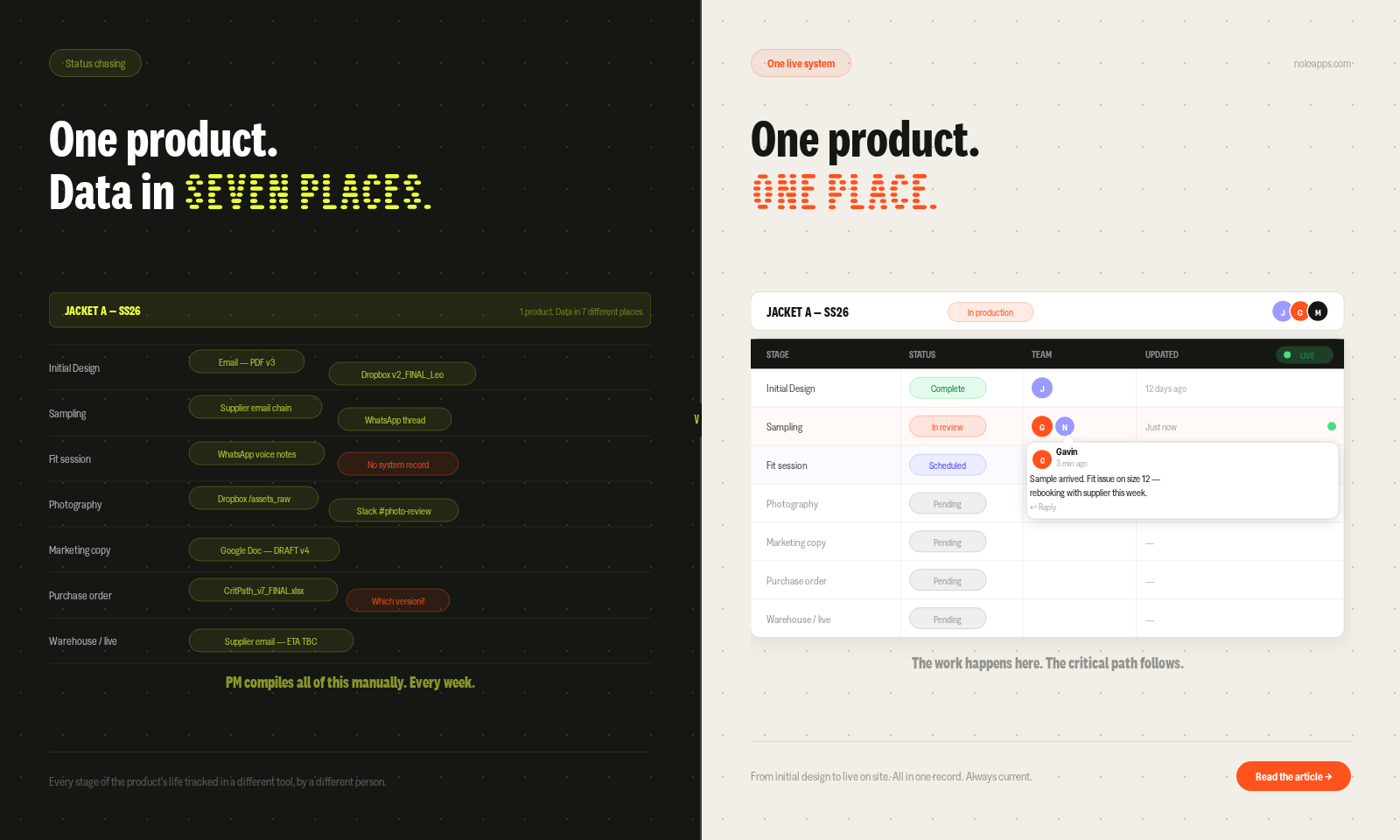
But tracking was never the problem. The work happening at each stage of the critical path isn't captured as data. Sampling lives in email threads. Fabric approvals live in WhatsApp. Design feedback lives in Miro boards that nobody else can parse. Supplier communication lives in 500 emails a day. The knowledge is there. It's just stored in places where no system can see it.

So you hire a human to manually compile the picture. That's your internal PM. They attend the meetings, chase the updates, build the status report, and present it to the room. By the time they've finished, half of it is already out of date.

The critical path as a tracking tool is a dead end. You're asking people to do the work, then separately log the work, then a third person compiles what was logged. Three layers of overhead to find out something that the data should already tell you.

What actually happens on it

The value isn't in the path. It's in understanding what happens at each stage in enough detail that the picture surfaces automatically.

I was working with a brand recently where we mapped their entire product journey in granular detail. Concept through to launch, every handoff, every decision point, every place where information moves between teams. Mapping the journey made one thing clear: every stage needed to capture what was actually happening as structured data, so it could surface automatically.

Take sampling. If you capture when a sample was requested, what type, who the supplier is, when it was sent, when it arrived, what the fit feedback was, whether it needs a re-send (all of that as structured data), then you don't need someone to tell you where sampling is at. The system tells you. It rolls up per garment, per category, per collection. You can see the gaps and the bottlenecks without asking anybody.

The same principle applies at every stage. If design decisions are captured as data rather than buried in a Miro board, you can see which products are stuck in development. If supplier lead times are tracked against actual delivery dates, you can see which suppliers are consistently late. If production dates are entered as things happen rather than retrospectively, the critical path view builds itself from the work.

The critical path becomes an output of structured data. Something the system builds from the work, rather than a document someone has to maintain.
"The critical path is treated as a project management tool: a tracking artefact that someone has to maintain. That framing is the problem. And it's why internal project management, in its traditional form, is collapsing."

Oliver Rhodes, CEO, Nolo Apps

The cost of status chasing

The 'we need better project management' conversation tends to skip over one thing: what interruptions actually cost.

Every time someone stops what they're doing to answer a question about where something is, they lose the thread of whatever they were actually working on. A production coordinator fielding ten "where's my sample?" messages a day isn't just losing the time it takes to reply. They're losing focus time around each interruption.

If that information is surfaced in a system that people can check without asking, the coordinator gets their day back. The marketing team can see what's arriving and when without sending an email. The founder can check the collection status without calling a meeting.

The internal PM role, in most brands I work with, is essentially a human router. They exist to transfer context between people who can't see each other's work. Fix the visibility problem at the data level, and that routing function disappears.

AI just accelerated this by five years

Once the data is in a good place, the idea of people manually updating task trackers just stops making sense.

We've been building Claude skills that run against structured operational data in Airtable. You can ask it to do a full sampling analysis against a collection and it produces a report that would take a human half a day to compile. You turn up at the meeting and the analysis is already done. "Here's where we're at. Should we talk it through?"

I saw Linear, the developer project management tool, relaunch recently with this exact philosophy baked in. They've essentially said: the tracking part of project management isn't going to be a thing anymore. You still take tickets. But you have to go and do the coding and then come back. People don't just want to track these bits. They want to do them.

The same is true for a fashion critical path. Nobody wants to spend their day updating a project tracker. They want to do the sampling, the design work, the production coordination. If the system captures what they're doing as they do it, the tracking takes care of itself.

The prerequisite matters though. The AI only works if the data underneath is clean and structured. Scatter information across emails, spreadsheets, and chat threads, and you get scattered output regardless of how good the tool is. The foundation work isn't optional.

What replaces the internal PM

The internal PM role splits into two things that look nothing like each other.

The first is systems architecture. Someone has to design how data moves between teams, where it's captured, what the stage gates are, and how visibility works across functions. That's senior, strategic work. It requires understanding the whole picture before touching any part of it, and it's done better by people who have seen the pattern across multiple businesses. A Gantt chart doesn't help here.

The second is change management. Getting people to actually capture data as they work rather than keeping it in their inbox. Designing interfaces that fit how teams naturally operate rather than forcing everyone into the same view. Building trust in the system so people stop maintaining their parallel spreadsheets. That work is irreducibly human.

Both of those are external capabilities. They're what a partner brings in, not what you staff permanently. The systems architect designs the infrastructure. The change lead gets people through the transition. And the thing they replace, the internal PM compiling status updates and chasing deliverables, is the layer that collapses when the data architecture is right.

The question for every brand

You've got a critical path. Somebody built it. Somebody is supposed to maintain it. Probably nobody does, at least not consistently.

The question is whether you keep hiring people to chase the updates and compile the reports, or whether you fix the architecture so the data captures itself and the bottlenecks surface automatically.

One is a permanent overhead. The other is a one-time investment that compounds across every collection, every season, every year.