Nolo’s Platform Approach
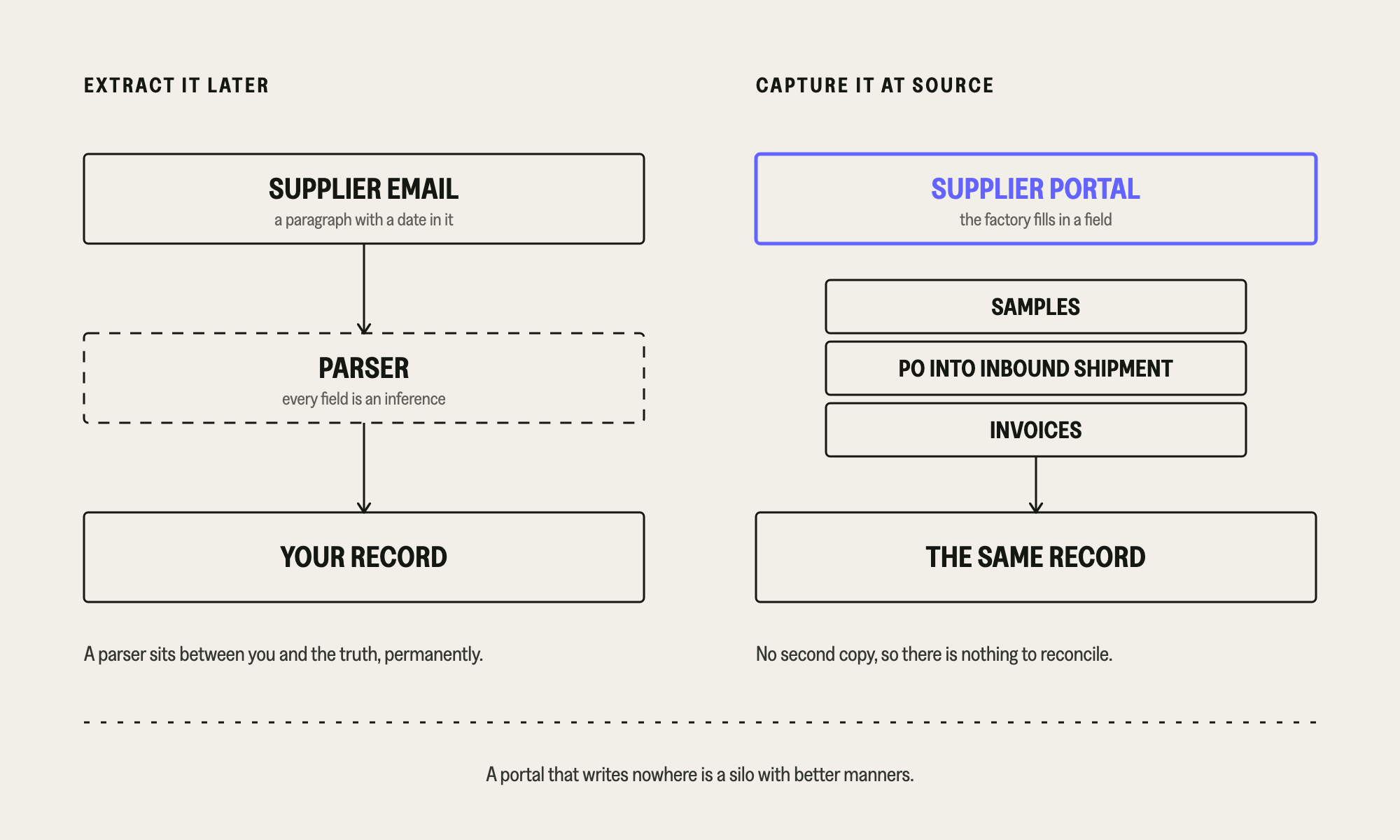
Instead of tracking when things should happen, you fix where product information lives.
When R&D updates a formulation, that change is immediately visible to everyone who needs it. Operations sees updated supplier requirements. Compliance sees the revised ingredient list. Sales sees current specifications. Marketing sees accurate product claims.
Not because someone sent an email or completed a task. Because everyone's working in the same platform, looking at different views of the same data.
The timeline still exists - stage gates, deadlines, dependencies, all of it. But now the timeline connects to actual product information, not references to information that might be outdated.
When compliance approves something, you know what they approved. When operations confirms supplier specs, you know everyone has the same version. When marketing launches a campaign, you know their claims are based on current product data. That level of certainty across all outputs frees up mental load and helps to lock in on achievable launch dates.
Where Does Airtable Fit In?
You can't solve this with spreadsheets and in fact, they're why you have this ‘failure to launch’ problem in the first place. You can't solve it with an ERP, which really are built for transactions after products are defined, not during that collaborative mess of development.
You need something structured enough to maintain data integrity, but flexible enough to match how product brands actually work.
Airtable is a database that people who aren't database administrators can use.
We build on Airtable a ‘Product Master’. It is one set of data, and teams access it through interfaces custom built for their roles:
- Product managers see launch timelines with stage gates linked to actual product data.
- Operations sees supplier tracking with specifications and delivery schedules.
- Marketing sees campaign planning connected to real product information.
- Sales accesses complete, current specs on mobile during retailer meetings.
- Compliance sees everything they need to approve in one view.
Most brands start with the pain point that's most obvious: launch coordination falling apart. The exact pain point project management tools are brought in to fix but rarely do.
Phase One: Connect Your Timeline to Your Product Data
You're managing multiple launches with stage gates, compliance checkpoints, supplier dependencies, and cross-functional teams. Currently that's a project tool showing tasks, plus countless spreadsheets, emails, and documents containing the actual work.
An Airtable platform brings them together. Stage gates connect to compliance records so you can see what was approved and when. Supplier delivery dates connect to actual supplier details and specifications. Marketing milestones link to campaign briefs that reference current product data.
This typically costs £5-8K to implement properly and can takes as little as a few weeks. It solves the immediate coordination crisis while proving the concept and getting teams bought into the Airtable platform approach.
After a few months working this way, the team stops thinking about "completing tasks" and starts thinking about "maintaining accurate product data." The questions change: Can we track all supplier costs here? Can compliance manage documentation here? Can we sync this to Shopify?
Phase Two: Your Complete Product Platform
This is the full solution. Not just timeline visibility, but the actual product master driving your entire operation.
SKU management, variant tracking, supplier relationships, costing models, compliance documentation, retailer spec sheets, marketing campaign planning, integrations to your ERP or ecommerce platform.
Typically £25-40K depending on complexity. But you're not guessing and flying blind here. You've been working in the platform for months and the whole team now knows what they need to do their jobs properly.
Adding In A Functional AI Layer
Everyone's trying to figure out how AI helps operations. The problem is that AI needs structured data to be useful.
If your product information is scattered across project tools, spreadsheets, emails, and supplier documents, AI has nothing to work with.
But when your product data lives in a proper platform:
- AI extracts specifications from supplier PDFs automatically
- Flags cost anomalies across your supplier base
- Suggests product attributes based on your existing catalogue
- Generates retailer spec sheets from your master data
- Identifies compliance issues before they become problems
- Spots supply chain risks from delivery patterns
Airtable rebuilt their platform this year around AI. Features like document extraction, intelligent matching and automated categorisation work because the underlying data is structured and accessible.
The brands that win with AI aren't the ones writing the best prompts. They're the ones who saw the real issues first, and organised their product data to work with AI.
Fast Forward - What We Offer At Scale
Jaded London manages 20,000+ SKUs in Airtable. They create products on mobile, negotiate with suppliers in real-time, sync to Shopify automatically, and handle complex attribute management for their online store.
Beauty brands use it differently. They might have fewer SKUs but there is more complexity. Multi-market variants with different regulatory requirements. Retailer-specific packaging. Compliance across regions. Influencer programs. Campaign planning tied to launch dates.
All on Airtable, but with completely different implementations. It adapts to how you work, not the other way around.
The Window for Getting This Right
You can take on a project like this at any time. In our experience, there’s an optimal window where the chances of long-term success are at their highest.
Too early (5 people, 12 SKUs): Spreadsheets work fine. The overhead isn't worth it yet.
Too late (50 people, entrenched processes): You're facing organisational change management, not just implementation. Consolidating data from fifteen sources while retraining twenty people.
Right now (post-initial-success, pre-chaos): You're big enough that disconnected product data costs real money. Small enough that implementation takes weeks, not months. You're hiring senior people who expect proper systems.
Every month you wait, the problem compounds. New launches reinforce bad habits. New hires learn your fragmented approach or start to bring in their own tools on top of what you already have. Each new SKU multiplies the coordination complexity.
The work gets harder while the need gets more obvious.


.png)