The stack that held them back: how Rat & Boa rebuilt their product operations
By early 2024, Alister Hewitt had already tried to fix the problem.
He'd had developers from Linnworks and Zedonk on the same call. The goal was simple: push purchase orders from Zedonk, the production system Rat & Boa had been running for 8 years, directly into Linnworks, their warehouse management system.
The developers spent the session explaining why it couldn't be done. There was no API on the production order side. It wasn't a matter of prioritisation or budget. Zedonk's integration architecture had a ceiling, and they'd hit it.
Alister walked away without a solution. A few months later, he came across Nolo's work on LinkedIn.
Rat & Boa had always moved fast. The London resortwear label was founded in Thailand in 2015 by Valentina Muntoni and Stephanie Bennett, and grew quickly through Instagram — a brand with the right aesthetic at the right moment, building an audience organically before the traditional fashion industry had noticed it.
By 2024 the brand had grown to £30m in revenue, 45 employees, 4 Shopify Plus stores, and customers in over 200 countries. Muntoni and Bennett were building openly toward a full fashion house by 2028 and £100m by 2029.
The operational stack hadn't kept pace with any of it.
Zedonk had been the production team's system since near the start. On paper it was the source of truth for all product data: costings, purchase orders, supplier management, production orders. In practice, the data barely left it.
Zedonk had been built for wholesale brand operations: trade show ordering, line sheets, retail buyer management. Rat & Boa were a DTC brand. They'd grown up using a wholesale ERP as their product master, and by 2024 the mismatch had accumulated into something structural.
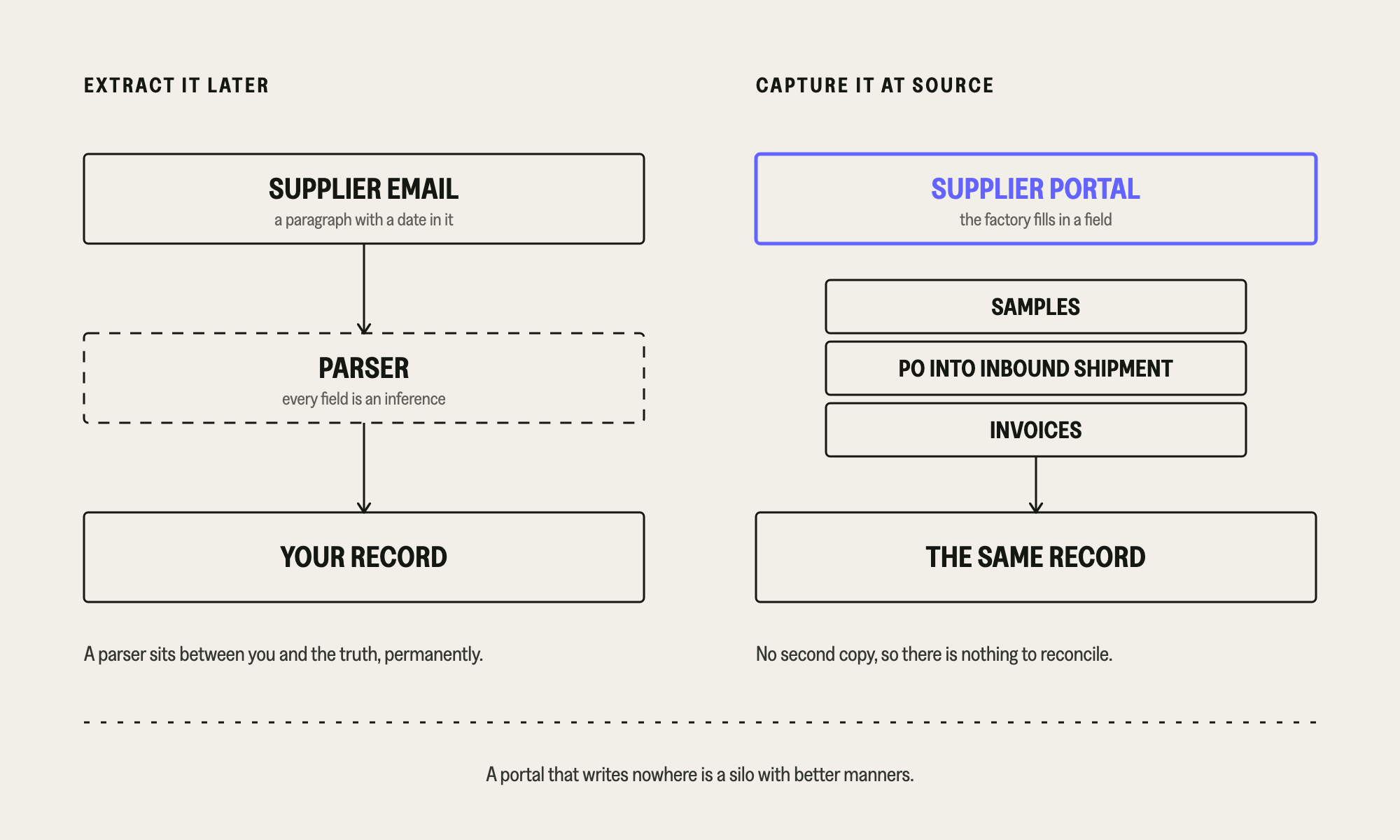
Zedonk was a closed ecosystem. No webhooks. A tightly limited API. Every attempt to connect it to the rest of the stack hit the same architectural wall. That developer call hadn't been unusual. It was the predictable outcome of trying to make a system do something it was never designed to do.
Around that closed system, the team had built a parallel infrastructure of spreadsheets to compensate. Around 1,500 of them, by Sandra López's count. This was the Dark Stack: product data scattered across systems that couldn't talk to each other, held together by one person's working knowledge.
Sandra was Rat & Boa's production manager and the person who held all of this together. Every style in development was entered into Zedonk. Product information was then exported to Excel, transferred manually to a Google Sheet, and distributed to whoever needed it.
This wasn't a workaround Sandra had chosen: Zedonk had no way to give other teams live access to the data. So every question about a product spec, every costing request, every time someone on the buying team needed to know where a collection stood, went through Sandra, then back to whoever was asking.
"Zedonk was her little walled garden which wouldn't let anyone in," Alister said. "She had all these hacks to get around using their system. It was impossible to onboard anyone else."
"Every question about where a collection is up to goes to Sandra, she relays it back, and everyone ends up in a meeting about it," Alister said.
The consequences were real. Inventory figures inside Zedonk didn't sync back from Shopify, so the module had been abandoned entirely.
The tech pack upload function required adding files page by page, a limitation so frustrating that Sandra had stopped using it and was keeping everything in a separate folder, outside the system she was supposed to be maintaining. A twice-yearly flash sale required 2 full days of manually merging data from 5 different platforms just to produce a single pricing file. One misaligned merge, and the wrong products went on sale at the wrong price.
The business was running at scale without any of its production data being visible, accurate, or connected in real time. Sandra was the integration layer. That worked until it didn't.
When Alister came to Nolo, the problem he brought was a specific integration. What happened in the first discovery session was something different.