So, what can we do about it?
If you want shared goals without foggy ownership, design the project so responsibility can’t evaporate.
At Nolo Apps, this is the part we care about most - not theory, but what you can do as an intention that changes the shape of the work.
Here are three practical design requirements:
- Clear ownership - who is on the hook for what
- Visible contribution - helps effort stay high
- Fast feedback loops - so reality corrects the plan
1. Make single-thread ownership the default
For anything that spans multiple teams, assign one accountable owner. Not a status-chaser. An integrator - the person responsible for making the whole thing move.
This counters diffusion of responsibility by removing ambiguity about who acts first.
A simple rule that saves projects:
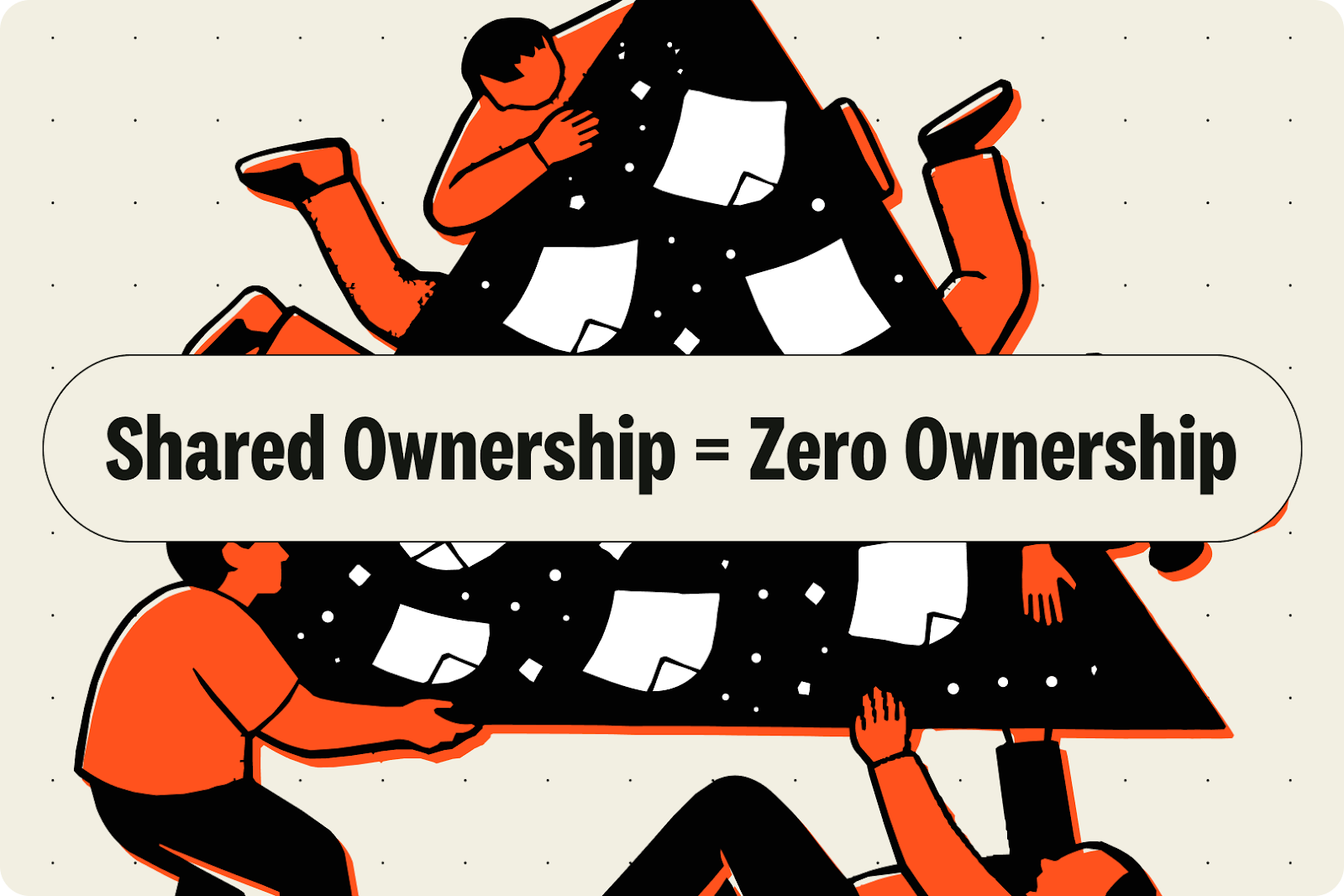
If it needs more than one team to complete it, it needs exactly one named owner to drive it.
This is where a lot of projects get weirdly emotional, because people confuse ownership with control. It’s not control - It’s stewardship.
2. Clarify decision rights where it matters
You don’t need a 40-row RACI spreadsheet. You need simple clarity on the decisions that shape delivery.
Make sure to clarify who makes the decisions on:
- the big scope trade-offs
- the risky dependencies
- the “go/no-go” moments (testing, cutover, launch readiness)
- anything that keeps coming back as “with someone”
Role ambiguity predicts worse performance, so this is not bureaucracy - it’s friction removal.
Include minimum viable decision clarity:
- Who decides?
- Who executes?
- Who must be consulted?
- Where is this written down?
This information needs to be visible where people actually work - not in a forgotten folder or doc no-one looks at, or done as a meeting discussion. And it needs to be explicit, not implicit.
3. Make contribution identifiable - name the work
Social loafing is heavily influenced by whether individual effort is visible and attributable.
Make the work visible at the level that matters:
- every action has an owner (a person, not “the Ops Team”)
- every action has a due date
- every action has a definition of done - one sentence, no more, no less
- every action has a next step - what happens immediately after this is done
If your tracker can tell you status but can’t tell you ownership, it’s not a project system. It’s a mood board.
(We’re good with mood boards. Just not as a delivery mechanic.)
4. Build accountability without blame
Accountability changes how people think and act when it’s expected and real.
The trick is to make it normal, lightweight, and forward-looking. Not a threat of ego attack based on things that can’t be changed (spoiler alert: none of us can change the past).
A pattern that works:
- Start meetings with “actions closed” before “new actions”
- Overdue actions get neutral prompts: “What changed? What do you need? What’s the new date?”
- Never “Why didn’t you do that?”
- Keep it factual. No drama. Progress over performance is the focus.
This keeps accountability from turning into theatre - or worse, silence.
5. Turn intentions into if-then plans
Implementation intentions work because they remove ambiguity at the moment action needs to happen.
Upgrade your action language from “Review vendor feed” to “If vendor feed arrives by Tuesday 12:00, then Alex validates columns A–F against spec v3 and posts pass/fail by 17:00.”
This is one of those changes that feels almost too simple until you realise how many projects are run entirely on vibes rather than reality.
6. Set goals that have edges, and give feedback that’s real
Specific and challenging goals with useful feedback drive performance better than ambiguity.
So instead of “Complete UAT” try “By Friday 17:00, close 30 priority test cases, with zero P1 defects open, and owners assigned for any remaining P2s with fix dates.”
Edges create traction → Traction creates progress → Progress creates engagement.
7. Shrink the execution group at delivery point
Big groups are good for alignment. Small groups are good for delivery.
As delivery group size grows, diffusion and loafing risks increase - especially when contribution is hard to see.
Keep the wide stakeholder circle, but create small delivery cells for outcomes:
- 2–4 people
- one accountable owner
- clear deliverables
- short-cycle check-ins where progress is evidenced, not narrated
8. Watch for hero compensation and fix the system, not the person
Sometimes the project works because one or two people compensate for the fog - they chase, patch, decide, and rescue. Social psychology shows this can happen when people expect others to underperform on meaningful tasks.
If you spot it, don’t praise it and move on. That’s how you bake burnout into your model.
Instead:
- make the glue work explicit
- redistribute ownership
- make escalation safe and normal
- stop relying on informal heroics as the real project plan - this is short term gain for long term pain when the heroic performers check out without warning.
The Kick
You don’t fix project issues by asking engaged teams to “take more ownership” or do more work. You fix it by designing an environment where ownership is clear, contribution is visible, and follow-through is normal.
- Diffusion of responsibility is real - remove ambiguity.
- Social loafing is real - make contributions identifiable and acknowledged.
- Role ambiguity is real - clarify decision rights and boundaries, and make sure they are explicitly known.
- Accountability effects are real - build calm report-back loops that focus on progress, not past activity.
- Intention is not execution - use specific goals and if-then planning.
Projects rarely fail because people don’t care. They fail because the system quietly makes it reasonable for everyone to care about the cost, but still assumes someone else will pick up the tab.
And that stray cat stays outside. In the cold.
References and models cited:
- Darley, J. M. and Latané, B. (1968) - diffusion of responsibility / bystander intervention.
- Latané, B., Williams, K. and Harkins, S. (1979) - “Many Hands Make Light the Work” (social loafing).
- Karau, S. J. and Williams, K. D. (1993) - meta-analysis; Collective Effort Model.
- Williams, K. D. and Karau (1991) - social compensation (sometimes people work harder in groups).
- Tubre, T. C. and Collins, J. M. (2000) - meta-analysis on role ambiguity and performance.
- Lerner, J. S. and Tetlock, P. E. (1999) - accountability effects.
- Locke, E. A. and Latham, G. P. (2002) - goal-setting theory overview.